
Understanding Property Tax Appeal Deadlines: What You Need to Know

The property tax appeal deadline is your final opportunity to dispute an unfair property tax assessment. Missing this date means accepting your current valuation and its associated tax burden for at least another year.
Property tax assessment appeals are governed by strict state and local filing deadlines. Missing the applicable deadline can cause an owner to lose the ordinary right to challenge that year’s assessment. However, the vary by jurisdiction, and some states permit late filings in limited circumstances, such as good cause, failure to receive required notice or qualifying military service. Property owners should therefore confirm the rules that apply to their property and file well before the deadline.
Types of Appeal Deadlines
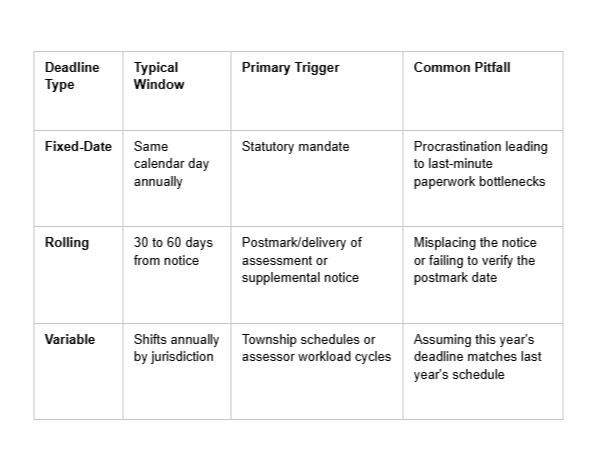
Property tax appeal systems generally fall into one of three structural categories:
- Fixed-Date Deadlines: The appeal cut-off lands on the exact same calendar day every year (and is the next business day if the deadline for the year falls on a weekend or public holiday), regardless of when notices are mailed.
- Examples: Massachusetts (February 2), Ohio (March 31), and Texas (May 15).
- Rolling Deadlines: The filing window opens when your individual assessment notice is postmarked or distributed, giving you a specific number of days to respond.
- Examples: California and many larger metropolitan counties frequently utilize a 30-day or 60-day rolling window from the notice date.
- Variable Deadlines: Deadlines fluctuate year-to-year based on local assessor workloads, political shifts, or township reassessment schedules.
- Example: Cook County, Illinois, splits deadlines by individual townships, causing appeal windows to open and close multiple times throughout a single calendar year.
State-Specific Examples & Cycle Triggers
Deadlines are deeply intertwined with local assessment cycles—the periodic schedules counties use to update property values. Reassessments are typically triggered by market schedule updates, changes in ownership, new construction, or major renovations.
California
Standard annual property tax appeals must be filed between July 2 and either September 15 or November 30, depending on the county. However, special assessments trigger accelerated rolling windows:
- Supplemental Assessments: 60 days from the notice date.
- Escape Assessments: 60 days from the notice date.
Texas
Texas utilizes a hard deadline of May 15. The only exception occurs if your notice was mailed late, which triggers a rolling 30-day window from the new postmark date.
Illinois (Cook County)
Deadlines vary entirely by township and are directly tied to the county's shifting three-year reassessment rotation.
Comparative Overview: Deadline Frameworks
Step-by-Step Appeal Preparation
A successful property tax appeal requires early organization and hyper-local evidence.
1. Track the Timeline
- Log into your local county assessor's portal to confirm your property's specific window.
- Establish digital calendar alerts for two critical dates: the day the appeal window opens and one week before it closes.
2. Audit Property Records
- Pull your county's public property record card.
- Verify factual data for errors, checking for incorrect square footage, inaccurate room counts, or unpermitted structural additions.
3. Compile Comparative Evidence
- Select 3 to 5 comparable properties ("comps") in your immediate neighborhood or school district.
- Ensure these comps match your property type and age, and were sold as close to the official assessment lien date as possible.
- Gather supporting secondary documentation, such as independent professional appraisals, certified repair estimates, or photographic evidence of property damage.
4. File Early and Retain Proof
- Submit your petition well ahead of the final cut-off to avoid system outages or administrative delays.
- Always save time-stamped digital confirmations or certified mail receipts to verify compliance with the deadline.
Emerging Trends in the Appeal Process
The landscape of property tax administration is transitioning away from legacy manual operations toward automated systems.
- Standardization Legislation: Structural variations cause widespread confusion for portfolio managers. In California, lawmakers and tax officials are examining reforms to make property tax assessment appeals more consistent and accessible across counties and their current proposals address filing deadlines, electronic submissions and other procedural differences.
- Digital Government Portals: Jurisdictions are continuously replacing paper-and-mail workflows with centralized online dashboards. These systems allow property owners to review parcel maps, submit evidence digitally, and track appeal statuses in real time.
- Advanced Reassessment Tracking: Local governments increasingly leverage data analytics to cross-reference building permits, deed transfers, and MLS listings, resulting in faster and more frequent reassessment triggers.
Written by Team LowPropTax
Empowering property owners with the data and strategies needed to successfully appeal unfair assessments and achieve permanent tax relief.