
Is a Property Tax Appeal Worth the Effort?

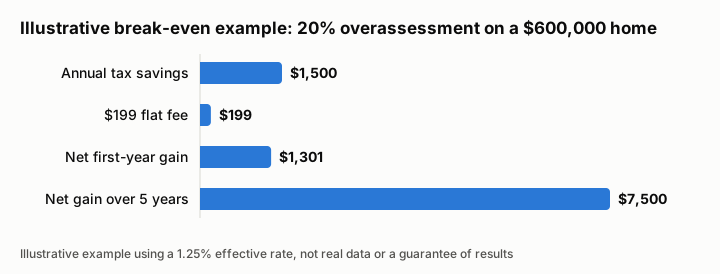
A property tax appeal is usually worth it when the expected tax savings clearly exceed your filing costs and the hours you spend—and in California, one successful appeal can save well over $1,000 a year. Because of Prop 13, that reduction typically carries forward, so a single win can keep paying for years. In our illustrative example—a $600,000 home assessed 20% above market, taxed at a 1.25% effective rate—a successful appeal cuts the bill by about $1,500 a year. The question isn't "do appeals work" but "does the math work for your property." Here's the framework.
Key takeaways
- Break-even is a simple comparison: expected tax savings in year one plus the carry-forward years, minus filing costs and the dollar value of your time.
- Prop 13 makes appeals compound. Under California's Proposition 13, a reduction to your assessed value usually persists as the base year value grows by no more than 2% a year, so a 10% cut is worth roughly 10% of your tax bill for as long as you own the home.
- Deadlines vary by county. In Sacramento County, the regular appeal window runs July 2 through September 15 for that year's roll; other counties set their own dates, so confirm with the county assessor.
- A free estimate comes before any fee. Estimate your likely savings first; only then does the cost of filing matter.
- Low-cost filing changes the break-even. At a $199 flat fee, the threshold for "worth it" is low—often a single-digit percentage overassessment.
What does a property tax appeal actually change?
A property tax appeal asks your county assessment appeals board to lower the assessed value—the dollar figure the county uses to calculate your tax bill—because it doesn't reflect market conditions on the lien date. It does not change your tax rate, renegotiate your mortgage, or protest a tax bill's errors (that's a different process). The appeal targets one number: the value on the assessor's roll.
In California, that value is governed by Proposition 13 (the 1978 law that caps the general property tax rate at 1% of assessed value and limits annual increases to 2%). The catch: if you bought when prices were high and your area has since softened, your assessed value can sit well above what a buyer would pay today. That gap is what an appeal closes. To see how the mechanics work step by step, the assessment appeal overview walks through the lifecycle of a claim.
Is a property tax appeal worth it? Run the break-even math first
An appeal is worth the effort when your expected savings over the years you'll own the property exceed the cost of filing plus the value of your time—and in most California cases with a real overassessment, the numbers clear easily. The method:
- Estimate your overassessment. Find your assessed value on your county's property tax bill or assessor portal, then compare it to recent comparable sales (your realtor, a valuation model, or an appeal service can do this).
- Convert it to dollars. Multiply the likely reduction by your effective total tax rate—county rates plus voter-approved debt and special assessments, often 1.1%–1.35% depending on the county. Use your actual bill to get this right.
- Multiply by the years it carries. Because of Prop 13, a permanent reduction keeps saving you money as the base year value grows. A five-year view is a reasonable planning horizon.
- Subtract your costs. Filing fee (some counties charge one; check yours), professional fees if you use them, and your time. Ten hours of evenings at a $50 hourly value is $500—real money even when the filing itself is cheap.
Here's the illustrative example that feeds the chart above:
Item: Market value (comparable sales) — Amount: $500,000
Item: Assessed value on the roll — Amount: $600,000
Item: Overassessment — Amount: 20%
Item: Effective tax rate — Amount: 1.25%
Item: Annual tax savings if reduced to market — Amount: $1,500
Item: Flat-fee appeal cost — Amount: $199
Item: Net first-year gain — Amount: $1,301
Item: Net gain over 5 years (savings not compounding) — Amount: $7,500
Those are illustrative figures, not a promise of results—your savings depend on your county's rate and how far off your assessment is. But notice the shape of it: at a $199 flat fee, even a 5% overassessment on a $600,000 home (about $375 a year) pays for the fee in year one. The break-even is very low.
What does it cost in time and money—and when is it not worth it?
A DIY appeal typically takes several evenings to gather comparables and complete the county's forms, while a flat-fee service can cut that to a document upload and a few minutes. Sacramento County's application, for example, asks for property details, your opinion of value, and supporting evidence; packets commonly run to dozens of fields. Multiply the hours by what your time is worth, add any county filing fee, and set that against the savings from the math above.
When an appeal is probably not worth it:
- Your assessed value is already at or below recent comparable sales.
- You bought recently at market price—your base year value likely reflects what you paid, and that's hard to attack.
- You're appealing out of principle, not overvaluation: a $200 annual difference on a low-cost property may not cover even modest time costs.
- You missed the deadline; a late filing is usually rejected, though rules differ by county.
Weighing a flat fee against a no-win-no-fee arrangement? The comparison in flat-fee vs contingency appeals explains when each structure favors the owner.
How do California's deadlines and refunds affect whether it's worth it?
Missing the deadline makes the question moot, and refund timing affects your cash-flow math—so check both before filing. In California, each county sets its own window. Sacramento County's regular filing period runs July 2 to September 15 to appeal that year's assessment roll. Many other counties follow a similar summer-to-fall window, but they are not identical—Los Angeles, San Diego, and Bay Area counties each publish their own dates. Confirm yours on the county assessor's site or your tax bill; our guide to property tax appeal deadlines covers the seasonal pattern.
Refunds don't arrive instantly. If the appeals board reduces your value, the county auditor applies the change going forward, and excess taxes already paid for the affected year are typically refunded—often after the board's decision, which can come months after filing. Plan on the savings showing up next year's bill or as a refund check, not next week.
DIY, a law firm, or a flat-fee service—which is worth it?
A DIY filing is cheapest in dollars, a law firm or contingency consultant is best for complex commercial cases, and a flat-fee service is the best value when the overassessment is real but the case is routine. The differences:
Approach: DIY filing — Typical cost: County fee (if any) — Time from you: 5–15 hours — Best for: Confident owners with clean data
Approach: Contingency consultant — Typical cost: 25%–40% of first-year savings — Time from you: Low — Best for: High-value cases with uncertain outcomes
Approach: Hourly law firm / consultant — Typical cost: Varies widely; ask for a quote — Time from you: Low — Best for: Complex commercial property
Approach: Flat-fee service — Typical cost: Fixed fee, e.g., $199 — Time from you: Minutes — Best for: Routine residential and small commercial
Two rules of thumb. First, never pay a fee before you've seen an estimate of what you might save—if a provider can't model your value, that's a red flag. Second, for commercial or multi-unit property, confirm the provider can handle income-approach valuation, not just residential comps. A checklist for vetting providers lives in what to look for in a property tax appeal service.
This is where a veteran-owned California specialist with automated valuation modeling earns its keep. We run your property through comparable-sales modeling and only file when the system predicts meaningful savings—so you see the expected reduction before you commit. When it does file, the fee is a flat $199, not a percentage of your win; that flat model is our answer to the contingency-vs-flat-fee question. It's a strong option precisely because the risk to you is capped at a small fixed amount while the upside—a lower base year value under Prop 13—keeps paying.
Property managers get a second angle: appeals on your managed portfolio are a risk-free ancillary revenue stream with no added headcount or tax expertise required. For owners, the equivalent first step is a free savings check.
FAQ
Is a property tax appeal worth it in California?
Usually yes if your assessed value is meaningfully above recent comparable sales. Because Prop 13 makes reductions stick and grow at no more than 2% a year, a successful appeal saves money year after year. The exception is when the overassessment is tiny relative to your time and fees.
How much can a property tax appeal save?
Savings equal your assessed value reduction times your effective tax rate. A 10% cut on a $600,000 assessment at roughly 1.25% is about $750 a year; a 20% cut is about $1,500. Your county's rate and your actual gap determine the real figure—check your tax bill.
How long does a property tax appeal take?
Filing takes an evening, or minutes with a service, but the county's review and appeals board hearing can take months. Reductions typically show up as an adjusted future bill or a refund rather than immediately. Build that lag into your cash-flow expectations.
Can I appeal every year?
You can file in each year your value looks too high, and annual review makes sense in a declining market. Each appeal is decided on that year's lien-date value, so a prior denial doesn't permanently block you. Our guide to what to do after a denied appeal covers next steps.
Is it worth hiring someone instead of filing myself?
If you have clean comps and the time, DIY works for straightforward cases. A professional earns their keep on valuation modeling, forms, and deadlines—especially for commercial property or when you're unsure how much to claim. Compare the fixed cost against your time.
What documents will I need?
Expect your tax bill, recent comparable sales or a valuation report, and the county's application form—Sacramento County's alone asks for detailed property and value information. Your county assessor's website lists the current requirements; start with the official Sacramento County Assessor page and the California Board of Equalization guidance on assessment appeals.
Check your savings for free
Before you weigh any fee, see the number that matters: the likely reduction on your property. Check your savings for free with a valuation model built on California comparable sales—if meaningful savings show up, filing is a flat $199, and you'll know exactly what you're buying before you pay anything.
Written by Team LowPropTax
Empowering property owners with the data and strategies needed to successfully appeal unfair assessments and achieve permanent tax relief.