
How to File a Property Tax Appeal Online

Filing a property tax appeal online costs nothing at most California counties, and the only question worth answering first is whether your assessment is actually too high. LowPropTax answers that before you touch a county portal: it runs an automated valuation check on your parcel and tells you whether it expects meaningful savings, and only then charges its flat $199 fee to file the appeal. If the model says you're fairly assessed, you've lost nothing but a few minutes and avoided a wasted filing.
If the check says you have a case, here is exactly how the online filing goes, from the Application for Changed Assessment to the evidence upload screen.
Key takeaways
- California county assessment appeals are filed with the clerk of the board of supervisors, not the assessor, and most counties now accept them through an online portal or by email.
- The five fields that sink appeals are the APN, the assessment roll year, the base-year value, your opinion of value and the comparable-sales evidence.
- You need three to five closed sales on similar properties, near your valuation date, with dates, square footage and adjusted values — not a Zestimate.
- The regular filing window in most counties runs from July 2 to September 15 for the following year's roll, but the formal notice you receive lists your specific deadline.
- A denied appeal isn't a dead end; you can often take the issue to an Assessment Appeals Board hearing, and overpayments can be refunded.
Before you spend an evening on a county portal, run your free savings check to see whether the math supports a filing at all.
What do you need before you start a property tax appeal in California?
You need five things before you file: your parcel's assessor's parcel number (APN), the assessment or roll year you're challenging, the assessor's current value for the property, evidence supporting your own opinion of value, and the filing deadline on your assessor's notice. An APN is the unique number a county assignst to your parcel for tax purposes; everything in the appeal hangs off it.
Gather these in one folder:
- Your most recent property tax bill or the assessor's value notice (it shows the APN, roll year and assessed value).
- Three to five comparable sales, closed and recorded, preferably within a mile and within the last 12 months.
- Your property's characteristics: living area, lot size, beds and baths, year built, and any condition issues.
- If you're an investor, your income and expense figures, in case the appraiser uses the income approach.
The official framework comes from the California State Board of Equalization, which publishes the Application for Changed Assessment (form BOE-305-AH) and the rules counties follow. Each county's clerk of the board publishes its own version and its own portal; the county mechanics guide covers how Sacramento, Los Angeles, San Diego, Alameda and the rest handle intake.
Step by step: how to file a property tax appeal online
You file online by creating an account or starting an unauthenticated form with the county clerk of the board, entering your parcel and valuation details, attaching your comparable sales and supporting documents, and submitting before the deadline. The screens differ in layout from county to county, but the fields are nearly identical — which is why you can rehearse on one county's portal and recognize every question on another's.

Step 1: Open the right portal
Go to the county's assessment appeals page, usually hosted by the clerk of the board rather than the assessor. In Sacramento, that's the Assessment Appeals Board section of the county site; Los Angeles County uses its Assessment Appeals Board online filing system; San Diego and Alameda each have their own portals or email intake instructions. Don't file on the assessor's website — the assessor doesn't decide appeals, and a decline-in-value request you submit there is not the same thing.
For plain-English background on the appeal-versus-protest distinction (protest is the term other states use), see property tax appeal vs. tax protest.
Step 2: Enter the parcel and roll details correctly
This is where most self-filed appeals fail on administration, not merit. The APN must match the assessor's record exactly — including the format the county uses (dashes, spaces, or a leading book-page-parcel sequence). The assessment roll year must be the year you're challenging as it appears on your notice, not the calendar year you're filing in; a 2026 filing often challenges the 2026-27 roll, and getting this wrong can get the application rejected as untimely or misdirected.
Step 3: State your opinion of value
"Requested opinion of value" or "opinion of value sought" means the number you believe the property was actually worth on the valuation date (usually January 1 of the roll year). Enter a specific dollar figure supported by your comps — not "too high" and not the purchase price if you bought years ago. If you claim a decline in value, the assessor's appraiser will compare your figure to market evidence, so a rounded guess undercuts your credibility.
One term trips people up here: the base-year value is the assessed value established when a property changes ownership or is newly constructed, which then grows by no more than 2% a year under Proposition 13. Your appeal isn't usually arguing the base year is wrong; it's arguing the current market value has fallen below the factored base-year value, or that the assessor's valuation of new construction or a purchase price was overstated.
Here's the field map for the screens you'll actually see:
Form field: Assessor's Parcel Number (APN) — What to enter: Exactly as printed on your tax bill — Why it matters: Mismatches cause rejection or a notice to the wrong property
Form field: Assessment/roll year — What to enter: The year on your notice, e.g., 2026-27 — Why it matters: Wrong year can be ruled untimely
Form field: Property address and type — What to enter: Full address; residential, commercial or other — Why it matters: Routes the appeal to the right appraiser
Form field: Base-year value — What to enter: Copy from the assessor's notice — Why it matters: Frames whether you're claiming decline in value
Form field: Current assessed value — What to enter: Total assessed value shown on the notice or bill — Why it matters: The starting point for your savings math
Form field: Opinion of value sought — What to enter: A specific dollar figure backed by comps — Why it matters: The number the board will evaluate
Form field: Evidence uploads — What to enter: Comparable sales, photos, income/expense if applicable — Why it matters: The only thing that decides the merits
Form field: Signature/declaration — What to enter: Your signature, electronic or scanned — Why it matters: Unsigned applications get rejected
Step 4: Package three to five comparable sales properly
Your comparable sales are the heart of the appeal. Choose closed, recorded sales of properties similar in size, age and location, sold as close to the valuation date as possible — ideally within 90 days to a year. For each one, include the address, sale date, sale price, living area, lot size, and any adjustment you make for differences (a pool, a larger lot, one more bedroom). Upload the county recorder's grant deed or the assessor's sales record for each comp, not a listing printout.
What gets evidence thrown out: active listings and pending sales (they aren't sales), comps from a different neighborhood class without explanation, screenshots without addresses, and Zestimates or automated estimates presented as appraisals. Many counties specify acceptable evidence formats in their instructions, so download the portal's evidence checklist and follow it exactly.
Step 5: Submit before your deadline and keep the receipt
Submit, save the confirmation number or email receipt, and print the completed application. Filing deadlines are the single most common way owners lose an appeal, so confirm yours against the notice you received and the county's published calendar.
Need the mechanics of the upload and confirmation screens in more detail? This step-by-step walkthrough of the online submission covers them.
If re-creating the comps and adjustment grid is the part you don't want to do yourself, that's exactly the work the flat $199 filing covers — and you can run your free savings check first to see whether the savings justify anyone filing at all.
Worked example: what does an appeal actually save?
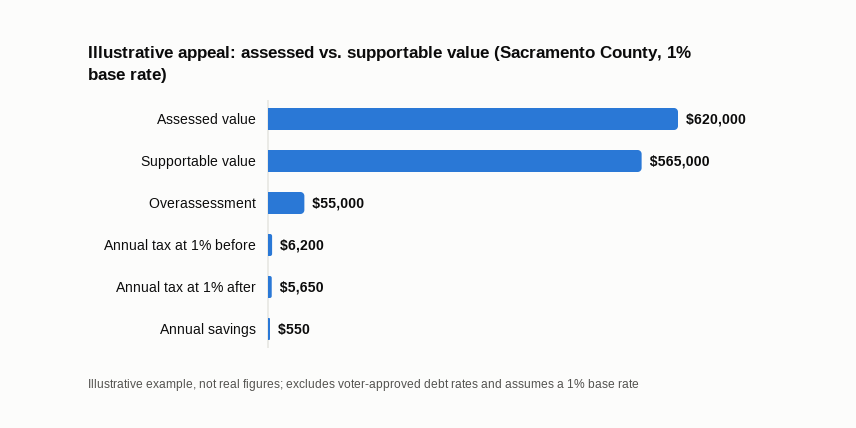
Here's an illustration of how the numbers work, using round figures that are not a real property. Say your home in Sacramento County is assessed at $620,000, and your comps support a value of $565,000 — an overassessment of $55,000. At the standard 1% base rate, that's $6,200 a year in tax before the appeal and $5,650 after, a saving of about $550 a year.
At a $199 flat fee, the filing pays for itself in roughly five months of tax savings, and the reduced assessed value carries forward in future years (subject to the annual inflation factor). That's the decision framework: if your evidence supports a value gap of tens of thousands of dollars, the fee is trivial; if the gap is a few thousand dollars, it may not be worth anyone's time.
What happens after a denial, and can you file without an agent?
You can absolutely file without an agent — it's free at most counties and the forms are designed for owners. If you're denied, you typically get a written decision and can request a hearing before the Assessment Appeals Board or, where offered, an informal review with the assessor; you may also have refund and equalization routes through the county and the state.

What does happen after a denial is worth understanding before you file, because a partial win is common: the assessor may agree to a lower value without a hearing, which is often the best outcome. If an overpayment occurred, refunds generally follow the county's rules and timelines. The full picture, including what a denial means for your refund, is covered in property tax assessment appeal.
If you're weighing DIY against hiring help, this comparison of a flat-fee appeal service vs. contingency firms shows where the cost models differ.
FAQ
When is the deadline to file a property tax appeal in California?
Most counties accept assessment appeals from July 2 through September 15 for the following year's roll, but the exact deadline is printed on your assessor's notice, and a few counties and property types use different windows. Check your notice first, then the county clerk of the board's published calendar. Filing late is usually rejected outright, so don't rely on a general rule.
Can I file a property tax appeal myself without an agent?
Yes. Filing on your own costs nothing at most counties, and the forms are written for property owners. The catch is evidence quality: the application will be judged on your comparable sales and adjustments, so a sloppy comp set can lose even a valid claim. Hiring help is about the analysis, not access to the portal.
What evidence do I upload with an online appeal?
Closed, recorded comparable sales — typically three to five — with addresses, sale dates, sale prices, living area and adjustments for differences, plus deeds or assessor records. Add photos of condition issues if relevant. Leave out active listings, automated estimates and unverifiable screenshots; counties routinely disregard them.
What happens if my property tax appeal is denied?
You'll receive a written decision, and you can generally request a hearing before the Assessment Appeals Board or pursue a refund route if you overpaid. Many appeals end in a negotiated reduction rather than a formal hearing. Keep your submission receipt and decision letter for any follow-up.
Do I have to pay my property taxes while the appeal is pending?
Yes. Filing an appeal doesn't pause the tax bill, and unpaid taxes can accrue penalties and interest regardless of the outcome. Pay on time, then pursue a refund of any overpayment after a successful appeal.
Bottom line
The online filing itself is the easy part — the APN, roll year, opinion of value and comps are where appeals are won or lost. Before you spend the evening on a portal, find out whether your numbers support a filing. Run your free savings check before you file at LowPropTax — if the model predicts meaningful savings, the $199 flat fee and the filing are handled for you; if not, you just saved yourself the paperwork.
Written by Team LowPropTax
Empowering property owners with the data and strategies needed to successfully appeal unfair assessments and achieve permanent tax relief.